INTRODUCTION
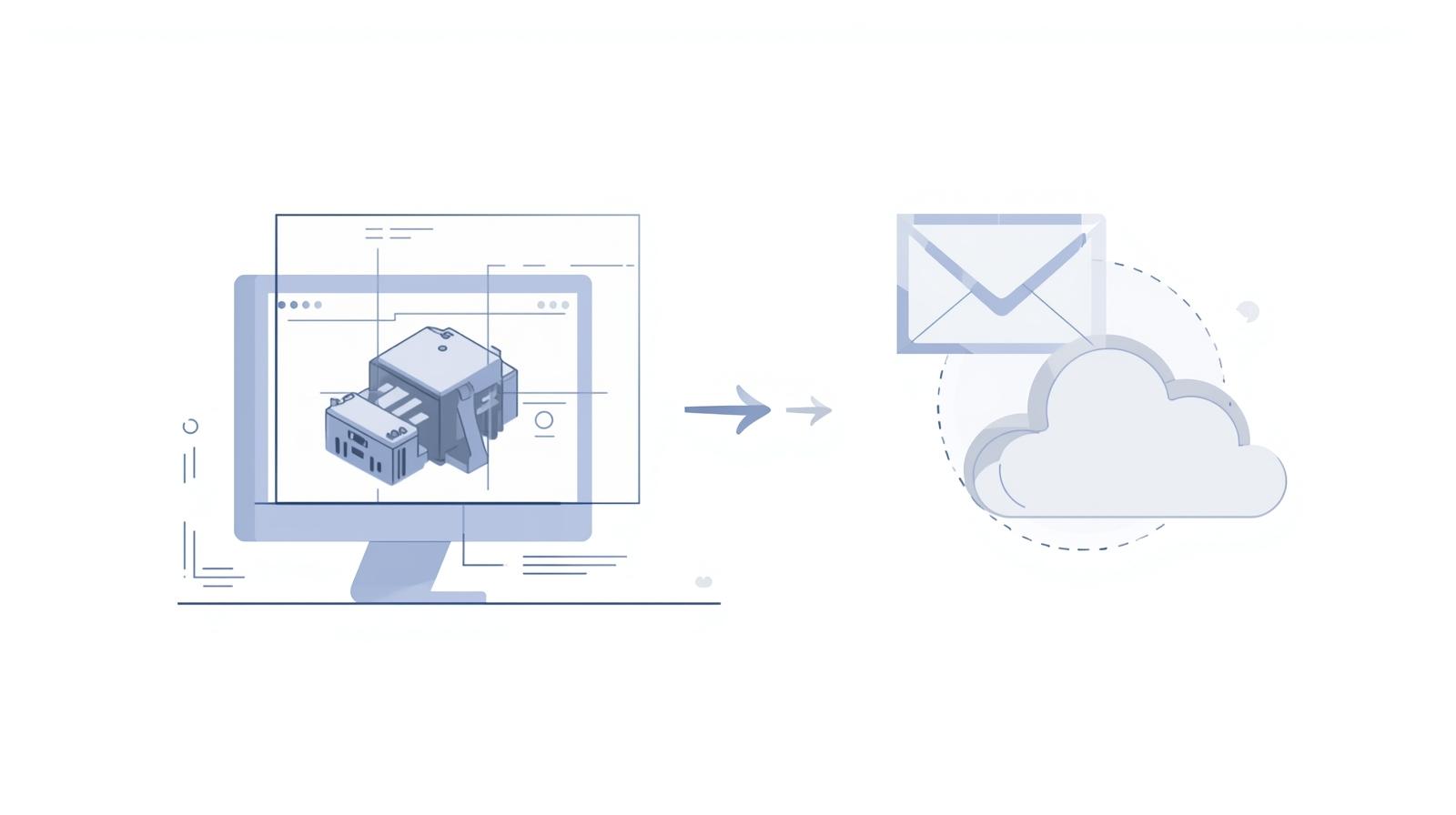
It starts innocently enough. You export a design, attach the 45MB STEP file to an email, and hit send. Two days later, the client replies: "I can't open this. Do you have a PDF?" Or worse, your manufacturer replies to an email from three weeks ago, manufacturing a part based on Assembly_v2.step instead of Assembly_v4_FINAL.step.
If this sounds familiar, you are trapped in the "Email Black Hole."
While email is the backbone of business communication, it is catastrophically bad for 3D engineering data. It destroys version control, exposes your intellectual property, and forces your collaborators to jump through expensive software hoops just to see what you've designed.
In this guide, we'll explore why the industry is abandoning email for CAD collaboration, the hidden costs you're paying right now, and the browser-based workflows that are replacing them.
Table of Contents
- The "Black Hole" of Email Attachments
- The Hidden Cost: Calculating the "Admin Tax"
- The Modern Workflow: Browser-Based & Instant
- Practical Implementation: How to Transition
- Common Mistakes to Avoid
- Conclusion
The "Black Hole" of Email Attachments
When you email a STEP file, you aren't just sending data; you are creating a static snapshot that immediately becomes obsolete. The moment that file leaves your outbox, you lose all control over it. Here is why the "attach and pray" method is failing modern engineering teams.
The Version Control Nightmare
Every engineer has a folder that looks like a graveyard of good intentions: Design_v1, Design_v2_Edit, Design_FINAL, Design_FINAL_REAL.
When you email these files, you create "data silos." Your manufacturer has one version, your sales team has another, and you are working on a third. This isn't just annoying; it is expensive. According to research by Lifecycle Insights, "version confusion" accounts for up to 15% of rework costs in hardware development projects [1]. That is thousands of dollars wasted because someone opened the wrong email attachment.
The "Viewer Tax" (Hardware Barriers)
Sending a STEP file assumes the recipient has the hardware and software to open it. This is rarely true for non-engineers.
- Clients often lack CAD licenses.
- Sales teams work from laptops that can't handle heavy geometry.
- Executives want to view designs on mobile devices.
When you force a recipient to download a viewer or request a PDF conversion, you are adding friction to the process. You turn a 5-minute review into a 2-day ordeal.
Security: You Just Leaked Your IP
Email is inherently insecure for sensitive intellectual property. Once a file is downloaded, it can be forwarded to anyone, uploaded to public servers, or stored on insecure personal drives.
A 2024 manufacturing cybersecurity report noted that 47% of IP theft incidents involved email or unsecured file sharing [2]. If you are emailing unencrypted STEP files, you are essentially handing your proprietary designs to the open web.
The Hidden Cost: Calculating the "Admin Tax"
We often ignore the time spent on file management because it feels like "part of the job." But let's look at the data.
Engineers spend a staggering amount of time on non-engineering tasks. A recent Tech-Clarity study found that engineers spend up to 30% of their time on non-value-added tasks, including searching for data, converting file formats, and managing transfers [3].
Consider the "Email Loop" workflow:
- Export STEP file (5 mins)
- Zip file to bypass email limits (2 mins)
- Upload/Attach (3 mins)
- Write email context (5 mins)
- Wait for feedback (24-48 hours)
- Receive feedback, decipher vague screenshots (15 mins)
- Repeat.
This latency kills momentum. In a fast-paced market, losing days to email lag is a competitive disadvantage.
The Modern Workflow: Browser-Based & Instant
The industry is shifting toward "Zero-Install" environments. The goal is simple: the person viewing the file should not need a $5,000 workstation or a $2,000 CAD license.
Universal Browser Access
Modern tools render 3D data directly in the cloud, streaming pixels rather than geometry to the device. This democratizes design data. A procurement manager on an iPad should be able to spin, zoom, and inspect a complex turbine assembly just as easily as the engineer who designed it.
Pro Tip: The Vizcad Advantage
If you are struggling with stakeholders who can't open your files, tools like VizCAD solve this instantly.
Vizcad's Universal Browser-Based Access allows anyone to open and view STEP, STL, and OBJ files instantly in any browser. There is no software to install and no heavy file transfers. You simply send a link, and they view the model in high fidelity—even on mobile.
👉 Try Design Sharing with Viz-CAD Now — Free
Real-Time Feedback Loops
Instead of vague email chains ("Can you move that bolt to the left?"), modern platforms allow for direct annotation on the 3D model.
Teams using real-time 3D collaboration tools have been shown to reduce feedback cycles by 40% compared to email-based workflows [4]. When a client can rotate the model and pin a comment directly to a specific surface, ambiguity disappears.
Single Source of Truth
By moving away from attachments, you shift to a "Single Source of Truth" model. The file lives in one place (the cloud). Everyone looks at the same link. If you update the design, the link reflects the latest version instantly. No more v2_FINAL emails.
Practical Implementation: How to Transition
Moving a team off email is 80% psychology and 20% technology. Here is how to execute the switch without causing a revolt.
Step 1: Audit Your "Heavy" Senders
Identify who sends the most attachments. Is it the design team sending updates to manufacturing? Is it sales sending prototypes to clients? Target these high-friction loops first.
Step 2: Implement a "Link-First" Policy
Establish a rule: No attachments over 10MB. Anything larger must be shared via a secure link. This forces the adoption of cloud tools without banning email entirely.
Step 3: Leverage Smart Sharing
Use tools that allow you to control how the recipient interacts with the data.
Expert Insight: Secure Your Shares
With Vizcad's Smart & Instant Sharing, you replace clunky attachments with a single, controllable link. You can let a client view a model without giving them the ability to download the source STEP file, protecting your IP while still enabling collaboration.
👉 Go to the Viz-CAD Dashboard and Invite Your Team
Common Mistakes to Avoid
1. Using Generic Cloud Storage (Dropbox/Drive)
While better than email, generic cloud storage is just a "hard drive in the sky." It doesn't solve the viewing problem. The recipient still has to download the file and have CAD software to open it. Always choose a platform with a native 3D viewer.
2. Ignoring Mobile Users
In 2024, decisions are made in airports, on job sites, and in coffee shops. If your sharing solution requires a desktop, you are blocking critical decision-makers. Ensure your tool offers cross-device performance.
3. Overlooking Access Rights
Never share a link that gives "Edit" access by default. Always default to "View Only" and elevate permissions as needed. This prevents accidental deletions or unauthorized changes to the master geometry.
Conclusion
Email was designed for memos, not megabytes. Continuing to rely on it for STEP file sharing is a choice to accept slower workflows, higher security risks, and increased rework costs.
By switching to a browser-based, link-sharing model, you achieve three critical wins:
- Security: Your IP stays on your platform, not in a stranger's inbox.
- Speed: Feedback loops shrink from days to minutes.
- Clarity: Everyone looks at the same version, every time.
Stop attaching. Start collaborating.
References
[1] Lifecycle Insights – The Cost of Design Rework in Hardware Development (2023)
[2] Kroll / Industry Week – Manufacturing Cybersecurity Threat Report (2024)
[3] Tech-Clarity – The State of Engineering Collaboration (2024)
[4] Engineering.com – Efficiency in Digital Engineering Workflows, Survey Results (2024)
Further Reading
Lifecycle Insights – Research on engineering efficiency
Tech-Clarity – Engineering software analysis
NIST – Cybersecurity Framework for Manufacturing
About the Author

Ferhat RudvanoğullarıMechatronics Engineer
Ferhat RUDVANOĞULLARI is a Mechatronics Engineer and the founder of Viz-CAD. Throughout his career, he has transferred the engineering perspective and system development experience gained from R&D projects into Viz-CAD, aiming to redefine engineering design processes through web-based solutions. Recently, he has focused his work on web-based 3D technologies and artificial intelligence applications, developing accessible, scalable, and innovative design infrastructures by bringing engineering tools to the browser environment.